Budget 2025

The Chancellor, Rachel Reeves, presented her Budget statement on 26 November 2025.

This is a brief round up of the main announcements affecting individuals and small business tax:

  • Personal tax and National insurance:
    • All main income tax and national insurance threshold will remain frozen until the end of the 2030-31 tax year (some allowances, such as the blind person’s allowance, continue to be uprated in line with inflation). This is an extension to the previously announced freeze, which was due to end in April 2028.
    • The lower earnings limit will increase to £6,708 (from £6,500) – this is the earnings at which employees receive a credit towards their state pension. This means that director-shareholders still needing state pension credits will need a salary of at least £6,708, which may mean their comany paying some employer national insurance.
  • Employer national insurance
    • The employer NI threshold (secondary threshold) will remain at £5,000 until the end of the 2030-31 tax year.
  • Pension contributions
    • From April 2029, the amount that is exempt from National Insurance contributions (NICs) under salary sacrifice for pension contributions will be capped at £2,000 a year.
    • Employer contributions will continue to be free of NICs.
  • Non-earned income tax rates
    • Dividends: The tax rate on dividends will increase by 2 percentage points from 6 April 2026. This means that dividends in the basic rate will be taxed at 10.75% and higher rate will be 35.75%. There is no change to the additional rate, which remains at 39.35%.
    • Savings income: Tax on savings income will increase by 2 percentage points across all bands from 6 April 2027. The basic rate will rise from 20% to 22%, the higher rate from 40% to 42%, and the additional rate from 45% to 47%.
    • Property income: The government is creating separate tax rates for property income. From April 2027, the property basic rate will be 22%, the property higher rate will be 42% and the property additional rate will be 47%. Finance cost relief will be provided at the separate property basic rate (22%).
    • The income tax ordering rules will be changed from April 2027 so that the Personal Allowance will be deducted against employment, trading or pension income first.
  • Corporation tax
    • There were no changes to the rates of corporation tax.
    • The late filing penalty for corporation tax returns will double (to £200 for the initial penalty) from 1 April 2026.
  • Capital allowances
    • From April 2026, the rate of writing-down allowance (WDA) on the main pool of plant and machinery will reduce from 18% to 14% per year. This will mainly affect businesses with pools of historic expenditure, as well as specific other asset purchases such as cars, since most capital spend can now be fully expensed (for companies), or is covered by the annual investment allowance (for companies and unincorporated businesses).
    • From January 2026, there will also be a new 40% first year allowance for spend applying to certain assets where full expensing or the annual investment allowance is not available. (Note: this will not be available for cars or second hand assets).
    • (Note: these measures are irrelevant for most small businesses, apart from in relation to receiving a smaller writing down allowance on low emission vehicles, since most of their expenditure is covered by the annual investment allowance).
  • Minimum Wage
    • The national living wage will increase to £12.71 (by 4.1%) with effect from April 2026.
    • The national minimum wage for 18-20 year olds will increase to £10.85 (8.5%), continuing the narrrowing of the gap between that and the NLW with a view to eventually creating a single adult rate.
    • The apprentice rate (and presumably the under 18 rate) will increase from £7.55 to £8.00 (6%) per hour.
  • Capital gains tax
    • There were no changes to the rates or allowances for capital gains.
  • Inheritance tax
    • IHT rates and thresholds remain unchanged and the thresholds will now be frozen until 2031 (a one-year extension to the previous freeze).
    • The £1m allowance announced for Agricultural and Business property announced in the 2024 Budget will be trasferreable between spouses and civil partners.
  • Property:
    • The government is introducing a High Value Council Tax Surcharge (HVCTS) in England for residential properties worth £2 million or more, from April 2028. The charges start at £2,500 per year, rising to £7,500 per year for properties valued above £5 million, and will be levied on property owners rather than occupiers.
    • As mentioned above, tax rates on property income will increase by 2 percentage points from April 2027.
  • Savings
    • ISA threshold total remains unchanged, however the cash ISA limit will be reduced to £12,000 for those under 65 from April 2027. This means that, to invest the full limit, at least £8,000 must be invested in stocks and shares.
    • As mentioned above, tax rates on savings will increase by 2 percentage points from April 2027, and the tax rate on dividends in the basic and higher rate band will increase by 2 percentage points from April 2026.
  • VAT
    • The VAT registration thresholds remain unchanged
  • Motoring
    • Fuel duties will be frozen until August 2026, after which rates will increase, gradually returning to March 2022 levels by March 2027.
    • There will be a new Electric Vehicle Excise Duty (eVED) from April 2028. This will be a 3p per mile charge for full EVs and 1.5p for plug in hybrids (PHEVs).
  • Other indirect taxes
    • Fuel duties will be frozen until August 2026, after which rates will increase, gradually returning to March 2022 levels by March 2027.
    • Alcohol duties will increase in line with RPI with effect from 1 February 2026
  • Other announcements
    • MTD ITSA penalties: There will be no late filing penalties for quarterly reports under MTD in 2026-7. Penalties will still apply if the final filing is late though.
    • Coding of self assessment tax payments: The government will require income tax Self Assessment taxpayers with Pay As You Earn (PAYE) income to pay more of their Self Assessment liabilities in-year via PAYE from April 2029. The government will publish a consultation in early 2026 on delivering this change, and on timelier tax payment for those with only Self Assessment income
    • Tax relief for working from home: From April 2026, employees will no longer be able to claim a tax deduction (the £6 per week that many claimed during Covid) for additional costs of working from home where these are not reimbursed by their employer. (This measure will not impact the existing ability for employers that reimburse employees for costs relating to homeworking where eligible without deducting Income Tax and National Insurance contributions.) (Note: I suspect that many have continued to claim post-Covid when they are probably not entitled, so it is simpler to just stop all claims than challenge them one by one!)
    • In-year reporting of dividends: The government will publish a consultation in early 2026 to explore introducing new requirements to report transactions between close companies and their shareholders to HMRC. The effect of this would be that owner managed businesses would have to report the dividends paid to their shateholders as they were paid.
Tagged , , , ,

Autumn Budget 2024

The Chancellor, Rachel Reeves, presented her Budget statement (and also reminded us that she is the first woman ever to do so) on 30 October 2024.

The main announcements relating to individuals and small businesses were:

  • Personal tax and National insurance:
    • As expected, all main income tax and national insurance threshold will remain frozen until the end of the 2026-7 tax year (some allowances, such as the blind person’s allowance, continue to be uprated in line with inflation).
    • An unexpected future bonus though: thresholds will start to increase by inflation again with effect from 6 April 2028.
  • Employer national insurance
    • Employer national insurance will increase to 15% (from 13.8%) with effect from 6 April 2025.
    • The employer NI threshold (secondary threshold) will decrease from £9,100 to £5,000 (announced in the budget, but the accompanying paperwork says £96 per week, which would be £4,992 – note that that is less than the lower earnings threshold, at which the employee is credited for their state pension, so those earning £9,100 currently won’t be able to simply reduce their pay to £5,000 if they need extra years for their state pension).
    • To compensate small employers, the employment allowance (the amount employers can deduct from their payments of employer NI each year) will increase from £5,000 to £10,500.
    • The £100,000 threshold for eligibility for employment allowance will be removed from 6 April 2025, meaning that most employers (a notable exception being those whose only employee earning over the secondary threshold is a director) will once again be eligible for the relief.
  • Corporation tax
    • The government published its ‘Corporate Tax Roadmap’, which confirms that the headline rate of corporation tax will be capped at 25% for this Parliament and the small profits rate of 19% and marginal relief will remain at their current rates and thresholds
  • Minimum Wage
    • The national living wage (‘NLW’ for 21+ year olds) will increase to £12.21 (by 6.7%) with effect from April 2025.
    • The national minimum wage for 18-20 year olds will increase to £10.00 (16.3%) in a move aimed at narrowing the gap between that and the NLW with a view to eventually creating a single adult rate.
    • The apprentice rate (and presumably the under 18 rate) will increase from £6.40 to £7.55 per hour.
  • Capital gains tax
    • The rates for capital gains tax for assets other than residential properties increase to 18% basic rate (from 10%) and 24% higher rate (from 18%) with effect from today (30 October 2024).
    • The capital gains tax rates for gains covered by business asset disposal relief (the first £1m of qualifying business asset gains) will increase from 10% to 14% from April 2025 and then to 18% from 6 April 2026.
    • The annual allowance remains at £3,000.
  • Inheritance tax
    • IHT rates and thresholds remain unchanged and the thresholds will now be frozen until 2030.
    • Pension fund balances will cease to be exempt from IHT with effect from 6 April 2027.
    • Agricultural and Business property reliefs will be reformed from 6 April 2026. The first £1m will be exempt from IHT and the remainder will be eligible for 50% relief (so effectively taxed at 20% as things stand currently).
    • Similarly, there will no longer be 100% relief for AIM listed shares, they will qualify for 50% relief.
  • Landlords and property:
    • The additional Stamp Duty Land Tax charge for the purchase of second and subsequent residential properties will increase from 3% to 5% with effect from tomorrow (31 October 2024).
  • ‘Non-Doms’
    • The concept of domicile will cease to exist and tax will be paid based on a new residence based system.
  • Savings
    • ISA thresholds remain unchanged
  • VAT
    • The VAT registration thresholds remain unchanged
  • Other indirect taxes
    • Fuel duties will be frozen for another year
    • Alcohol duties will increase in line with RPI with effect from 1 February 2025, apart from draught products below 8.5% ABV, which will decrease by 1p.
  • Other announcements
    • The interest rates on overdue tax (currently set at base plus 2.5%) will increase by 1.5 percentage points from April 2025 (so, to base plus 4%).
    • The official rate of interest (at which the benefit in kind is calculated on loans from a limited company) will now increase quarterly rather than annually. The headline says “Setting the official rate of interest for quarter 3 of tax year 2024 to 2025” and implies that it will change this year, but then goes on to say that in year increases may take place from April 2025, so it is a bit ambiguous as to whether there will be an immediate increase.
    • Hiddden in the small print of the accompanying documents was a note regarding a potential extenstion of making tax digital for income tax (MTD). MTD will require quarterly tax reporting for sole traders and landlords with a turover of £50,000 (from 6 April 2026) and then £30,000 (from 6 April 2027). The Budget documents set out the intention to extend this to sole traders and landlords with turnover of over £20,000 by the end of this Parliament.

Confirmation of the personal tax rates and allowances for 2025-26 can be found here: Annex A

Budget 2024

The Chancellor, Jeremy Hunt, presented his Budget statement on 6 March 2024.

The main announcements relating to individuals and small businesses were:

  • Personal tax and National insurance:
    • Employee national insurance was reduced from 12% to 10% in the Autumn Statement, with effect from 6 January 2024. The Chancellor announced a further reduction to 8%, to take effect from 6 April 2025.
    • Class 4 national insurance (paid by the self employed) will reduce from its current rate of 9% to 6% from 6 April 2024. (It was due to reduce to 8% from 6 April following the Autumn Statement).
    • All main income tax and national insurance threshold remain unchanged from the current tax year.
  • Child Benefit:
    • The starting threshold for the High Income Child Benefit Charge will increase from £50,000 to £60,000. It will taper over income up to £80,000 (increased from £60,000), so the rate of withdrawal will be halved. These are the first increases in the thresholds since it was introduced in January 2013!
    • The Government will consult on moving to a household based system from April 2026 (this is likely to be a challenge since there is no way of implementing this based on the current tax system).
  • Landlords and property:
    • The higher rate of capital gains tax for residential properties will reduce from 28% to 24% with effect from 6 April 2024. The lower rate remains at 18%.
    • The Furnished Holiday Lets regime will be abolished from April 2025.
    • SDLT multiple dwellings relief will be abolished from 1 June 2024 (these were rules that allowed less stamp duty to be paid if more than one property was bought at once – eg a block of flats).
  • ‘Non-Doms’
    • The current ‘Non-Doms’ tax system (which, in simple terms, deals with tax for individuals living in the UK who were not born here) will be abolished from April 2025. Non-Doms will start to pay the same tax as UK residents after 4 years of residency.
  • Savings
    • The government annoucned its intention to introduce a new UK ISA with its own allowance of £5,000 a year. They will consult on the details at a later date.
  • VAT
    • The VAT registration threshold will increase from £85,000 to £90,000 from 1 April 2024. The deregistration threshold will be £88,000.
  • Other indirect taxes
    • Fuel and alcohol duties will be frozen for another year
    • A new vaping profucts duty will be increased from 1 October 2026, alongside a proportionate increase in tobacco duties.

Confirmation of the personal tax rates and allowances for 2023-24 can be found here: Annex A

Previous announcements taking effect/continuing from April 2024:

  • Most income tax, national insurance and inheritance thresholds remain frozen until April 2028.
  • The dividend allowance will reduce from £1,000 to £500 from April 2024
  • The capital gains tax allowance will reduce from £6,000 to £3,000 from April 2024.
  • Compulsory class 2 contributions will no longer be payable from 5 April 2024 – individuals will still be able to pay voluntary class 2 to maintain their national insurance record where their profits are below the small profits threshold.
  • The Government will consult on the full abolishment of Class 2 national insurance later this year.
  • The national living wage will increase from £10.42 to £11.44 from 1 April 2024, and those aged 21 and over will be entitled to the full rate (previously, those aged 21-22 could be paid a lower rate). Details of the rates by age/category can be found here
  • Electric cars will start to be subject to vehicle excise duty (road tax) from April 2025.

To expand on some of the changes in more detail:

Income tax and national insurance

Apart from the reduction in the rates of employee and self employed national insurance, the rates of income tax and national insurance remain unchanged from their current levels.

The main tax and national insurance thresholds will be frozen at current levels until April 2028. (Some allowances, such as the blind person’s allowance, continue to be uprated in line with inflation).

Dividend tax

The rates of tax for dividends will remain at 8.75%/33.75%/39.35% (basic/higher/additional).

The dividend allowance will reduce from £1,000 to £500 from April 2024.

Capital gains tax

Capital gains tax for non-residential proprty gains remains at 10% (for gains falling into the basic rate band) and 20% (higher rate).

The rates for residentual property will be 18% and 24% (reduced from 28%).

The capital gains tax allowance will reduce from £6,000 to £3,000 from April 2024.

Furnished Holiday Lets (FHL)

The Furnished Holiday Lets regime will be abolished from April 2025.

The current benefits of FHLs are:

  • Interest charges are deductible from profits at marginal rates of tax rather than being restricted to 20% as they are for residential property lettings
  • You can claim Capital Gains Tax reliefs for traders (Business Asset Rollover Relief, Entrepreneurs’ Relief, relief for gifts of business assets and relief for loans to traders)
  • You’re entitled to plant and machinery capital allowances for items such as furniture, equipment and fixtures
  • The profits count as earnings for pension purposes

The abolishment will mean that furnished holiday lets will lose these benefits and be taxed in the same was as standard residential lets:

  • Interest will not be deductible from profits, it will be subject to the same restriction to 20% as existing residential lets
  • Capital gains tax will be at higher rates and will not benefit from trade reliefs
  • Furnishings and fixtures will only be deductible as and when they are replaced
  • Landlords relying on FHL income to provide relevant earnings for their pension contributions will no longer be able to do so.

Car and van benefit rates

In March 2023, the government set rates for Company Car Tax until April 2028. The rates continue to incentivise the take up of electric vehicles.

The appropriate percentages for electric and ultra-low emission cars emitting less than 75g of CO2 per kilometre will increase by 1 percentage point in 2025-26; a further 1% in 2026-27 and a further 1% in 2027-28 up to a maximum appropriate percentage of 5% for electric cars and 21% for ultra-low emission cars.

Rates for all other vehicles bands will be increased by 1 percentage point for 2025-26 up to a maximum appropriate percentage of 37% and will then be fixed in 2026-27 and 2027-28.

Car and Van Fuel Benefit Charges and van benefit charge will increase in line with CPI from April 2023.

Vehicle Excise Duty (VED)

From April 2025, electric cars, vans and motorcycles will begin to pay VED in the same way as petrol and diesel vehicles:

  • new zero emission cars registered on or after 1 April 2025 will be liable to pay the lowest first year rate of VED (which applies to vehicles with CO2 emissions 1 to 50g/km) currently £10 a year. From the second year of registration onwards, they will move to the standard rate, currently £165 a year
  • zero emission cars first registered between 1 April 2017 and 31 March 2025 will also pay the standard rate
  • the Expensive Car Supplement exemption for electric vehicles is due to end in 2025. New zero emission cars registered on or after 1 April 2025 will therefore be liable for the expensive car supplement. The Expensive Car Supplement currently applies to cars with a list price exceeding £40,000 for 5 years
  • zero and low emission cars first registered between 1 March 2001 and 30 March 2017 currently in Band A will move to the Band B rate, currently £20 a year
  • zero emission vans will move to the rate for petrol and diesel light goods vehicles, currently £290 a year for most vans
  • zero emission motorcycles and tricycles will move to the rate for the smallest engine size, currently £22 a year
  • rates for Alternative Fuel Vehicles and hybrids will also be equalised

Budget 2023

The Chancellor, Jeremy Hunt, presented his Budget statement on 15 March 2023.

The main announcements relating to individuals and small businesses were:

  • Pensions:
    • The pension contribution annual allowance will increase from £40,000 to £60,000 from 6 April 2023.
    • The Money Purchase Annual Allowance* and Minimum Tapered Annual Allowance** will increase from £40,000 to £10,000 from 6 April 2023.
    • The threshold for the Minimum Tapered Annual Allowance will increase from £240,000 to £260,000 from April 2023.
    • The Lifetime Allowance will be removed from 6 April 2023 and abolished from 6 April 2024 (technical difference), however, the maximum tax free lump sum will be retained at its current level of £268,275 and be frozen thereafter.
    • Top up payments will be made, from 6 April 2025 in respect of the tax year 2024-25, to individuals paying into a pension under a net pay agreement*** where their total income is below the personal allowance.
  • Energy:
    • The Energy Price Guarantee for households will remain at £2,500 until the end of June 2023 (previously due to expire at the end of March). The planned increase to £3,000 per year will take place from 1 July 2023.
    • Charges for prepayment meter users will be reduced to bring charges in line with comparable direct debit charges.
  • Corporation tax
    • Tax rates will increase from 1 April as previously announced.
    • ‘Full expensing’ for qualifying plant and machinery purchases will be introduced for 3 years from 1 April 2023. This means that companies will be able to write off the full cost of qualifying main rate plant and machinery investment in the year of investment. Those investing in special rate (including long life) assets will benefit from a 50% first-year allowance during this period. (This is unlikely to impact on small businesses since the Annual Investment Allowance remains at £1m and small businesses tend to spend less than £1m!).
  • Childcare
    • Children aged 9 months and over, with all adults in their household working at least 16 hours a week, will be entitled to 30 hours of free child care. This will be introduced in stages:
      • From April 2024: 15 hours per week for children aged 2
      • From September 2024: 15 hours per week for children aged 9 months and over
      • From September 2025: 30 hours a week for children aged 9 months and over
    • From September 2023, staffing ratios will be amended from 1 staff member to 4 children to 1:5 for two year olds
    • The Government will also substantially uplift the hourly funding rate paid to providers to deliver the existing free hours offers in England
  • Confirmation of the rates and allowances for 2023-24 can be found here: Annex A

* The Money Purchase Annual Allowance comes into effect when an individual has drawn funds from one of their money purchase pensions and limits the amount that can subsequently be paid back in to a pension.

** The pension annual allowance starts to reduce when earnings reach the upper threshold. The minimum that it can be reduced to is the Minimum Tapered Annual Allowance.

*** There are two different ways for employee contributions to receive tax relief:

  • Relief at source: Employee contributions are deducted from net pay (ie after deducting tax and national insurance) and paid over to the pension scheme before tax relief. A 20% tax credit is added directly to the scheme by HMRC, irrespective of the tax status of the individual. 40% tax payers then claim additional tax relief from HMRC. Non tax payers benefit from the 20% tax credit even though they don’t pay any tax. Nest and People’s Pension use a relief at source.
  • Net pay: Employee contributions are deducted from pay before calculating tax, and therefore the contributions paid over to the scheme include tax relief. This gives easier relief for 40% tax payers since they receive relief through their pay without having to claim extra relief from HMRC, but, currently, it means that non tax payers do not receive any tax benefit, hence giving an inequality between the two types of scheme. Defined benefit employer schemes commonly use the net pay method, as does Smart Pensions.

Previous announcements taking effect/continuing from April 2023:

  • Most income tax, national insurance and inheritance thresholds remain frozen until April 2028.
  • The 45p ‘additional rate’ tax band threshold will reduce from £150,000 to £125,140 from 6 April 2023.
  • The dividend allowance will reduce from £2,000 to £1,000 from April 2023 and then to £500 from April 2024.
  • The capital gains tax allowance will reduce from £12,300 to £6,000 from April 2023 and then to £3,000 from April 2024.
  • The stamp duty changes implemented as a result of the ‘mini-budget’ will now be temporary and will end in April 2025, at which point they will revert to their old limits.
  • The VAT registration threshold will be frozen at £85,000 until March 2026.
  • Research and development tax reliefs for small and medium sized enterprises (SME) will be reduced for spend after April 2023, but increased for businesses not qualifying for the SME scheme.
  • Benefits, including the state pension, will increase by inflation (10.1%) from April.
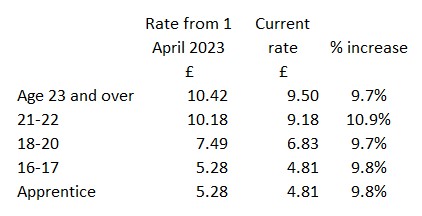
  • The national living wage will increase from £9.50 to £10.42 from 1 April 2023.
  • In the accompanying documentation, company car and van benefit rates to April 2028 were also set.
  • Electric cars will start to be subject to vehicle excise duty (road tax) from April 2025.

To expand on some of the previously announced changes in more detail:

Income tax and national insurance

The rates of income tax and national insurance remain unchanged from their current (ie post 5 November) levels, which are the same as they were in 2021-22.

The tax and national insurance thresholds, apart from the 45% tax threshold, will be frozen at current levels until April 2028.

The 45% tax threshold will reduce from £150,000 to £125,140 from 6 April 2023.
There is a reason for the seemingly odd figure of £125,140: for income above £100,000, £1 of personal allowance is lost for every £2 of income, giving an effective tax rate for earned income between £100,000 and £125,140 of 60%, so the 45% threshold has been set at the top of this band.

Dividend tax

The rates of tax for dividends will remain at 8.75%/33.75%/39.35% (basic/higher/additional).

The dividend allowance will reduce from £2,000 to £1,000 from April 2023 and then to £500 from April 2024.

Capital gains tax

Capital gains tax remains at 10% (for gains falling into the basic rate band) and 20% (higher rate) (18%/28% for residential property gains).

The capital gains tax allowance will reduce from £12,300 to £6,000 from April 2023 and then to £3,000 from April 2024.

Research and development tax relief

There will be changes to research and development tax reliefs from April 2023.

For small and medium sized enterprises, the enhanced deduction will be reduced from 130% to 86% and the repayable credit cut from 14.5% to 10%.

For businesses not qualifying for the SME scheme, relief will increase from 13% to 20%.

The government will consult on the design of a single scheme for all businesses.

National Minimum/Living Wage

The new rates will be as follows:

Car and van benefit rates

The government is setting rates for Company Car Tax until April 2028. Rates will continue to incentivise the take up of electric vehicles.

The appropriate percentages for electric and ultra-low emission cars emitting less than 75g of CO2 per kilometre will increase by 1 percentage point in 2025-26; a further 1% in 2026-27 and a further 1% in 2027-28 up to a maximum appropriate percentage of 5% for electric cars and 21% for ultra-low emission cars.

Rates for all other vehicles bands will be increased by 1 percentage point for 2025-26 up to a maximum appropriate percentage of 37% and will then be fixed in 2026-27 and 2027-28.

Car and Van Fuel Benefit Charges and van benefit charge will increase in line with CPI from April 2023.

Vehicle Excise Duty (VED)

From April 2025, electric cars, vans and motorcycles will begin to pay VED in the same way as petrol and diesel vehicles:

  • new zero emission cars registered on or after 1 April 2025 will be liable to pay the lowest first year rate of VED (which applies to vehicles with CO2 emissions 1 to 50g/km) currently £10 a year. From the second year of registration onwards, they will move to the standard rate, currently £165 a year
  • zero emission cars first registered between 1 April 2017 and 31 March 2025 will also pay the standard rate
  • the Expensive Car Supplement exemption for electric vehicles is due to end in 2025. New zero emission cars registered on or after 1 April 2025 will therefore be liable for the expensive car supplement. The Expensive Car Supplement currently applies to cars with a list price exceeding £40,000 for 5 years
  • zero and low emission cars first registered between 1 March 2001 and 30 March 2017 currently in Band A will move to the Band B rate, currently £20 a year
  • zero emission vans will move to the rate for petrol and diesel light goods vehicles, currently £290 a year for most vans
  • zero emission motorcycles and tricycles will move to the rate for the smallest engine size, currently £22 a year
  • rates for Alternative Fuel Vehicles and hybrids will also be equalised

Autumn Statement 2022

Following the disastrous ‘Mini-Budget’ in September, and the subsequent confusion and u-turns, the Chancellor, Jeremy Hunt, presented his Autumn Statement on 17 November 2022.

The statement, unlike the September statement, was fully supported by OBR (Office for Budgetary Responsibility) forecasts.

There has been a lot of speculation regarding tax increases over the past few weeks, may of which came to fruition, but, fortunately, three of the touted changes in respect of an increase in the rate of capital gains tax, an increase in the rate of dividend and a restriction in pension tax relief tax did not feature.

The main announcements relating to personal tax and small businesses were:

  • Most income tax, national insurance and inheritance thresholds will be frozen until April 2028.
  • The 45p ‘additional rate’ tax band threshold will reduce from £150,000 to £125,140 from 6 April 2023.
  • The dividend allowance will reduce from £2,000 to £1,000 from April 2023 and then to £500 from April 2024.
  • The capital gains tax allowance will reduce from £12,300 to £6,000 from April 2023 and then to £3,000 from April 2024.
  • The stamp duty changes implemented as a result of the ‘mini-budget’ will now be temporary and will end in April 2025, at which point they will revert to their old limits.
  • The VAT registration threshold will be frozen at £85,000 until March 2026.
  • Research and development tax reliefs for small and medium sized enterprises (SME) will be reduced for spend after April 2023, but increased for businesses not qualifying for the SME scheme.
  • The energy price guarantee will continue from April 2023 to April 2024, albeit with a higher typical bill limit of £3,000 per annum (up from £2,500). There will also be lump sum payments to those on certain benefits, pensioners and the disabled.
  • There will be a treasury review to determine the support for energy bills to be offered to businesses from next April.
  • Benefits, including the state pension, will increase by inflation (10.1%) from next April.
  • The national living wage will increase from £9.50 to £10.42.
  • In the accompanying documentation, company car and van benefit rates to April 2028 were also set.
  • Electric cars will start to be subject to vehicle excise duty (road tax) from April 2025.

To expand on some of the changes in more detail:

Income tax and national insurance

The rates of income tax and national insurance remain unchanged from their current (ie post 5 November) levels, which are the same as they were in 2021-22.

The tax and national insurance thresholds, apart from the 45% tax threshold, will be frozen at current levels until April 2028.

The 45% tax threshold will reduce from £150,000 to £125,140.
There is a reason for the seemingly odd figure of £125,140: for income above £100,000, £1 of personal allowance is lost for every £2 of income, giving an effective tax rate for earned income between £100,000 and £125,140 of 60%, so the 45% threshold has been set at the top of this band.

Dividend tax

The rates of tax for dividends will remain at 8.75%/33.75%/39.35% (basic/higher/additional).

The dividend allowance will reduce from £2,000 to £1,000 from April 2023 and then to £500 from April 2024.

Capital gains tax

Capital gains tax remains at 10% (for gains falling into the basic rate band) and 20% (higher rate) (18%/28% for residential property gains).

The capital gains tax allowance will reduce from £12,300 to £6,000 from April 2023 and then to £3,000 from April 2024.

Research and development tax relief

There will be changes to research and development tax reliefs from April 2023.

For small and medium sized enterprises, the enhanced deduction will be reduced from 130% to 86% and the repayable credit cut from 14.5% to 10%.

For businesses not qualifying for the SME scheme, relief will increase from 13% to 20%.

The government will consult on the design of a single scheme for all businesses.

National Minimum/Living Wage

The new rates will be as follows:

Car and van benefit rates

The government is setting rates for Company Car Tax until April 2028. Rates will continue to incentivise the take up of electric vehicles.

The appropriate percentages for electric and ultra-low emission cars emitting less than 75g of CO2 per kilometre will increase by 1 percentage point in 2025-26; a further 1% in 2026-27 and a further 1% in 2027-28 up to a maximum appropriate percentage of 5% for electric cars and 21% for ultra-low emission cars.

Rates for all other vehicles bands will be increased by 1 percentage point for 2025-26 up to a maximum appropriate percentage of 37% and will then be fixed in 2026-27 and 2027-28.

Car and Van Fuel Benefit Charges and van benefit charge will increase in line with CPI from April 2023.

Vehicle Excise Duty (VED)

From April 2025, electric cars, vans and motorcycles will begin to pay VED in the same way as petrol and diesel vehicles:

  • new zero emission cars registered on or after 1 April 2025 will be liable to pay the lowest first year rate of VED (which applies to vehicles with CO2 emissions 1 to 50g/km) currently £10 a year. From the second year of registration onwards, they will move to the standard rate, currently £165 a year
  • zero emission cars first registered between 1 April 2017 and 31 March 2025 will also pay the standard rate
  • the Expensive Car Supplement exemption for electric vehicles is due to end in 2025. New zero emission cars registered on or after 1 April 2025 will therefore be liable for the expensive car supplement. The Expensive Car Supplement currently applies to cars with a list price exceeding £40,000 for 5 years
  • zero and low emission cars first registered between 1 March 2001 and 30 March 2017 currently in Band A will move to the Band B rate, currently £20 a year
  • zero emission vans will move to the rate for petrol and diesel light goods vehicles, currently £290 a year for most vans
  • zero emission motorcycles and tricycles will move to the rate for the smallest engine size, currently £22 a year
  • rates for Alternative Fuel Vehicles and hybrids will also be equalised

Mini-Budget: update to the update to the update!

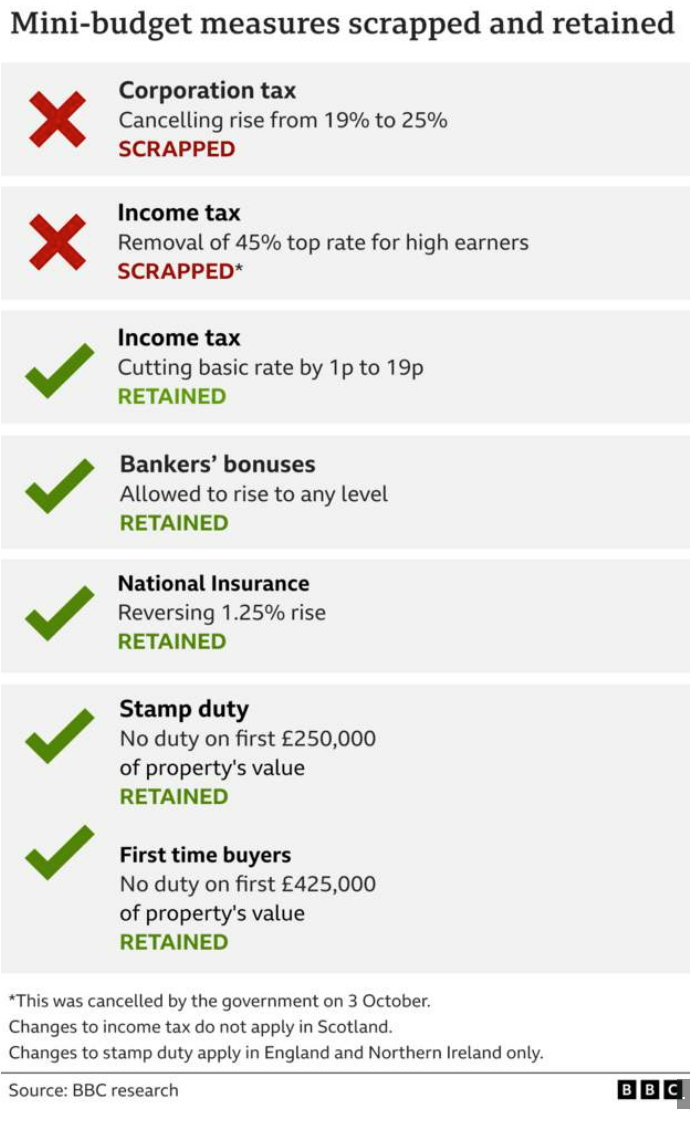
The new Chancellor, Jeremy Hunt, has just held a press conference to announce that all measures from the September mini-budget not already on their way through parliament will be cancelled.

He said that the cuts to National Insurance and Stamp duty will go ahead. All other measures will be cancelled.

In his announcement, he confirmed that:

  • The reduction to corporation tax will not go ahead (as announced on Friday)
  • There will be no cut to dividend tax
  • The IR35 2017 and 2021 changes will not be reversed
  • The VAT free shopping scheme will not go ahead
  • The freeze on alcohol duty will not go ahead
  • Income tax will remain at 20% indefinitely, until economic circumstances allow it to be cut.

In terms of the energy price guarantee, this was due to be in place for two years. The measures in place to April 2023 will remain, but there will be a Treasury-led review of support beyond that to give a new approach “to save taxpayers money while targeting support to those most in need”. Business support will go to those most affected and will incentivise energy efficiency

Another update

I am just going to put this here, nothing more to say until the next U-turn (thanks to the BBC news website!) ….

Update to Fiscal Statement

Following the turmoil in the markets caused by last month’s mini-Budget, the Chancellor announced, on 3 October 2022, that the government is abandoning plans to abolish the 45% top rate of income tax.

Fiscal Statement September 2022

Kwasi Kwarteng presented “The Growth Plan 2022” mini-budget on Friday 23 September 2022.

It was not a full budget, but contained key announcements relevant to individuals and small businesses which are summarised below.

National Insurance

As announced yesterday, the increase in employee and employer national insurance for the health and social care levy introduced in April 2022 will be cancelled with effect from 6 November 2022.

This means that for non-director employees and their employers, national insurance will revert to its previous rates of 12% (2% above the upper threshold of £50,270) for employees and 13.8% for employers from payrolls run after 6 November 2022.

The cut will also cover class 1A (employer benefits), directors’ and class 4 (self employed) national insurance.  However, since the reduction takes effect from 6 November and these taxes are calculated on an annual basis, there will be hybrid rates for the 2022-23 tax year.

Class 1A national insurance (normally aligned with employer national insurance) will be 14.53%.

For Directors, employee national insurance will be will be 12.73% (2.73% above the upper threshold of £50,270) and employer national insurance will be 14.53%.

Class 4 will be 9.73% for the main rate and 2.73% above the upper threshold.

The separate Health and Social Care levy due to come in from 6 April 2023 (at which point, national insurance was due to revert to its previous levels) will also be cancelled.

Income tax

Rishi Sunak had announced in the Spring Statement that the basic rate of tax would be reduced from 20% to 19% from April 2024.  Kwasi Kwarteng brought this forward, so that income tax will reduce to 19% from April 2023.

He also announced that the additional rate of tax of 45% will be abolished from April 2023, so that there will be a single higher rate of income tax for all earners of 40%.

The Income Tax rate cuts announced today do not apply to Scottish taxpayers since the Scottish Government set their own income tax rates and bands.

(Note: That does not mean that the highest marginal rate of income tax is 40% since the personal allowance is withdrawn at a rate of £1 for every £2 of income over £100,000, which gives an effective rate of income tax of 60% for earnings between £100,000 and 125,140.)

Dividend tax

The 1.25% increase in dividend rates implemented alongside the increase in national insurance rates will remain for the current tax year, but will be removed from April 2023.

The additional rate of dividend tax (currently 39.35%) will also be abolished from April 2023 in line with the removal of the income  tax additional rate of tax.

Business tax

Also announced yesterday, the increase in corporation tax rates due to take place in April 2023 will be cancelled, leaving corporation tax at 19%.

The Annual Investment Allowance (the maximum spend on capital items that can be written off in full in the year of purchase), which was due to fall from £1m to £200,000, will remain at £1m permanently.

There were also extensions to share option schemes to boost investment and employee share ownership.

The Chancellor also announced that the changes to IR35 (tax on service company workers) introduced in 2017 and 2021, pushing the onus on the end user to determine employment status, will be repealed from April 2023.

Charities

Charities can reclaim basic rate tax (currently at 20%) on donations made to them under Gift Aid.

The reduction in the basic rate of tax will reduce the tax that charities can claim under Gift Aid, however, there will be a four-year transition period for Gift Aid relief to maintain the Income Tax basic rate relief at 20% until April 2027.

Stamp Duty

The Chancellor announced a permanent increase in the nil rate band for stamp duty from £125,000 to £250,000.

The nil rate band for first time buyers will increase from £300,000 to £425,000 on the purchase of houses up to a value of £625,000 (increased from £500,000).

These changes will take effect from today.

Investment Zones

There will be new investment zones created throughout the company with tax incentives, such as accelerated tax relief for structures and buildings, 100% allowances on plant and machinery, nil rates of stamp duty and business rates and national insurance reliefs on new employee earnings up to £50,270 per year.

The government is in consultation with 38 local authorities (including Derbyshire, Nottinghamshire and Leicestershire) on the location of the zones.

Energy

The Chancellor confirmed the energy caps and financial help for domestic properties.

He also announced that businesses would be afforded similar protection.

The energy relief scheme is a temporary six-month scheme which will be reviewed after 3 months to inform decisions on future support.

Other duties

Alcohol duties will be frozen for a year from 1 February 2023.

A response to the previous consultation on future changes to the alcohol duty system was published today with reforms to introduced in August 2023.

Spring Statement 2022

Rishi Sunak presented the 2022 Spring Statement Budget on Wednesday 23 March 2022.

The Spring Statement is not a full budget – it normally gives an update on the state of the economy and sets out future plans.  Major changes are usually reserved for the main Budget in the Autumn.

However, given the current state of the economy, the Spring Statement this year did include some more immediate and significant changes which are summarised below.

National Insurance

The increase in national insurance for the health and social care levy will still go ahead.

However, the Chancellor announced that the primary threshold for national insurance (the level at which employees start to pay national insurance on their salaries) will increase from £9,880 (as previously announced from 6 April) to £12,570 with effect from 6 July.

This means that, for the 13 weeks to 6 July 2022, employees will pay national insurance (at the new rate of 13.25%) on income over £190 per week (£823 per month).  From 6 July, they will pay on income over £242 per week (£1,048 per month).

Good news too for the self-employed – the Class 4 National Insurance threshold (lower profits limit) will increase to £11,908 for the tax year 2022-23 (being 13 weeks at £190 and 39 weeks at £242).

The primary threshold for company directors will also be £11,908 (because their national insurance is calculated cumulatively over the year rather than on a monthly basis).

These measures bring the primary threshold for national insurance into line with the personal tax free allowance and the Chancellor announced that they would now remain aligned.

Class 2 National Insurance

More good news for lower earning self-employed individuals: currently, if your income is more than the small profits threshold (£6,725) you have to pay Class 2 National Insurance (which gives credit for state pension and other contributory benefits) at £3.05 per week.

The Chancellor announced that the self-employed will no longer have to pay class 2 national insurance if their earnings are between the small profits threshold and the lower profits limit (ie £6,725 to £11,908 for 2022-23), but they will still receive national insurance credits. (This brings them in to line with employees who have always received credits when earning between the two thresholds.)

Presumably, those with profits less than £6,725 will still have to pay voluntary class 2 national insurance at £3.05 per week if they want credits for their pension/contributory benefits.

Employment allowance

More help was announced for employers too.  Their national insurance thresholds remain unchanged, but the Employment Allowance (the amount of employer national insurance that small employers do not have to pay over to HMRC) will increase from £4,000 to £5,000 for 2022-23.

Fuel Duty

There will be a temporary 5p per litre cut in fuel duty from 6pm tonight for 12 months.

VAT on energy saving materials

VAT on the installation of energy saving materials (solar panels, heat pumps, insulation etc ) will be reduced to zero from April for the next five years.

(Note: Some measures currently qualify for a 5% VAT rate rather than 20%, but the rules are complex – the bottom line is that you won’t generally see prices reducing 1/6th as you would expect if 20% VAT was being removed).

Income tax

The ‘big’ accouncement was that the basic rate of tax will be reduced from 20% to 19% from April 2024.

Student Loan reform

Not announced in the Spring Statement, but still worth a mention are changes to Student Loans announced last month.

The repayment thresholds for plan 2 and plan 3 student loans have been frozen for the 2022-23 tax year, which gives an effective increase in repayments to students in real terms.

There are currently two main plans for student loans: plan 1 (loans taken out between 1998 and 2011) and plan 2 (loans since 2011) (there are also plan 3 (post graduate), plan 4 (Scottish) and pre 1998 loans).

For plan 1, graduates pay back 9% of income over £19,895 (£20,195 from 6 April 2022) per annum and are charged interest on the loan at the lower of RPI (retail price index inflation) or the Bank of England base rate +1%.

Plan 1 loans are written off either at age 65 (if you took the loan out in 2005-6 or earlier), or 25 years after the April in which the first payment was due (for loans 2006-7 or later).

For plan 2, graduates pay back 9% of income over £27,295 (no change from 6 April) per annum and are charged interest at RPI plus up to 3% (RPI+3% during your course up until 5 April after the end of the course, and then varying rates after that depending on your income – eg for income less than £27,295, interest is at RPI, if your income is over £49,130, the rate is RPI+3%).

Plan 2 loans are written off 30 years after the April in which the first payment was due.

For those starting university from September 2023 onwards, there will be a new plan.   The repayment threshold will be £25,000 and interest will be charged at RPI.  The length of time taken before a student loan is written off will increase to 40 years.